Ampoule · Rejuran
Rejuran Turnover Ampoule Dual Effect: what the Korean box actually says
Heads up: some links below are affiliate links, which means I may earn a small commission if you buy through them — at no extra cost to you. I bought this ampoule with my own money, and my honest opinion is never for sale.
The short answer
This is the at-home ampoule from the company behind Korea's salmon-DNA injectable. The Korean box prints its two figures on the side — c-PDRN 0.5% and n-PDRN 1.0% — which no export listing shows you. No fragrance in the list, no smell on my face, and it has never broken me out. Bought again ✓
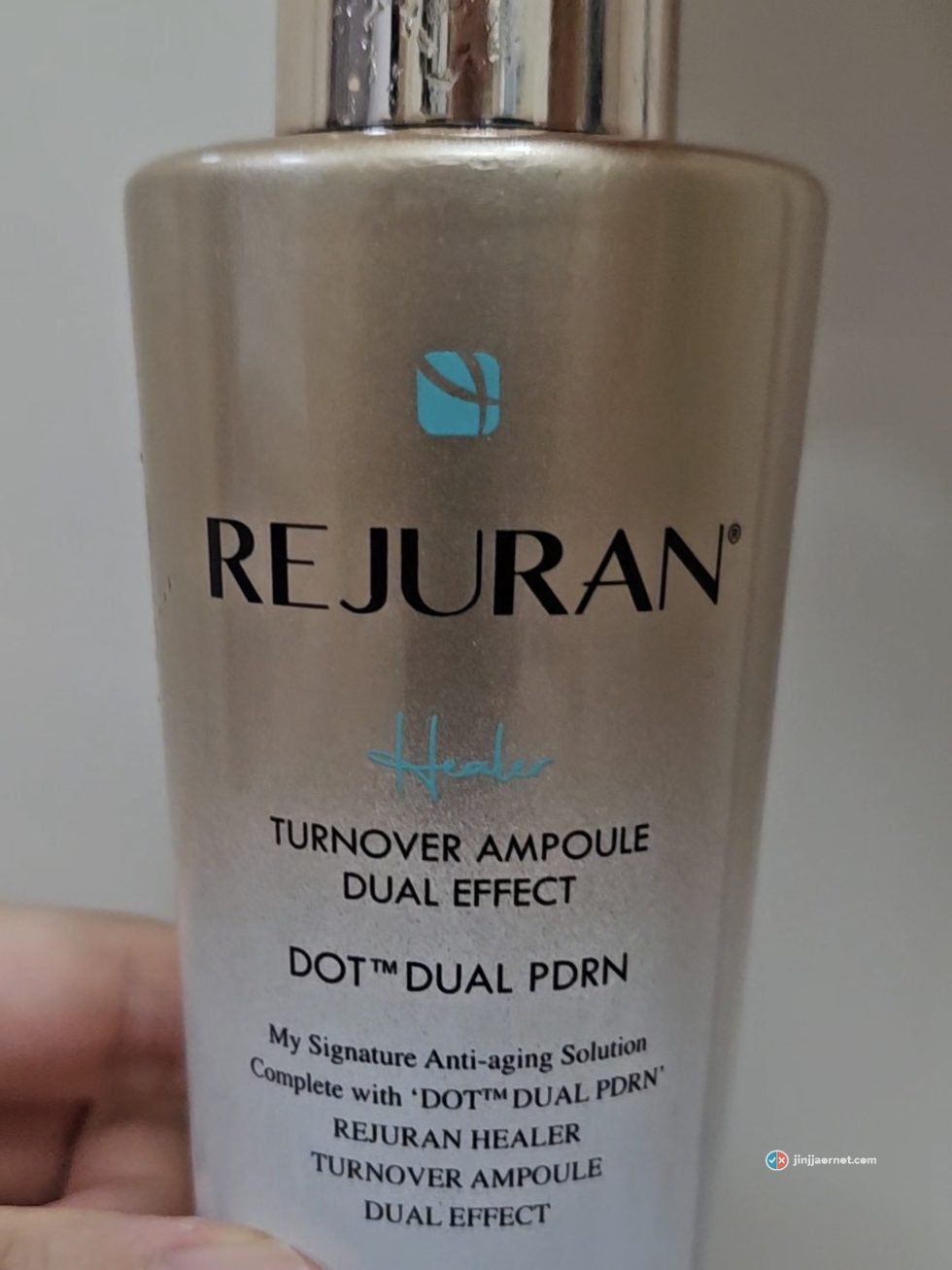
Rejuran is not a skincare brand that decided to sound clinical
It is the other way round. PharmaResearch makes the injectable that Korean clinics call Rejuran Healer, and this bottle is the brand's cosmetic line. That is why the box looks like something off a pharmacy shelf rather than out of a beauty aisle.
Say this part plainly, because a lot of English writing about this product blurs it: an ampoule you pat on is not the procedure. Nothing sold in a shop delivers what a needle delivers. What you are buying is the brand's ingredient story in a bottle you can actually use at home.
The numbers are printed on the side of the box
This is the part that does not travel. Korean cosmetics rules make brands print a concentration when the ingredient is part of the claim, so the Korean box carries two figures in plain type.
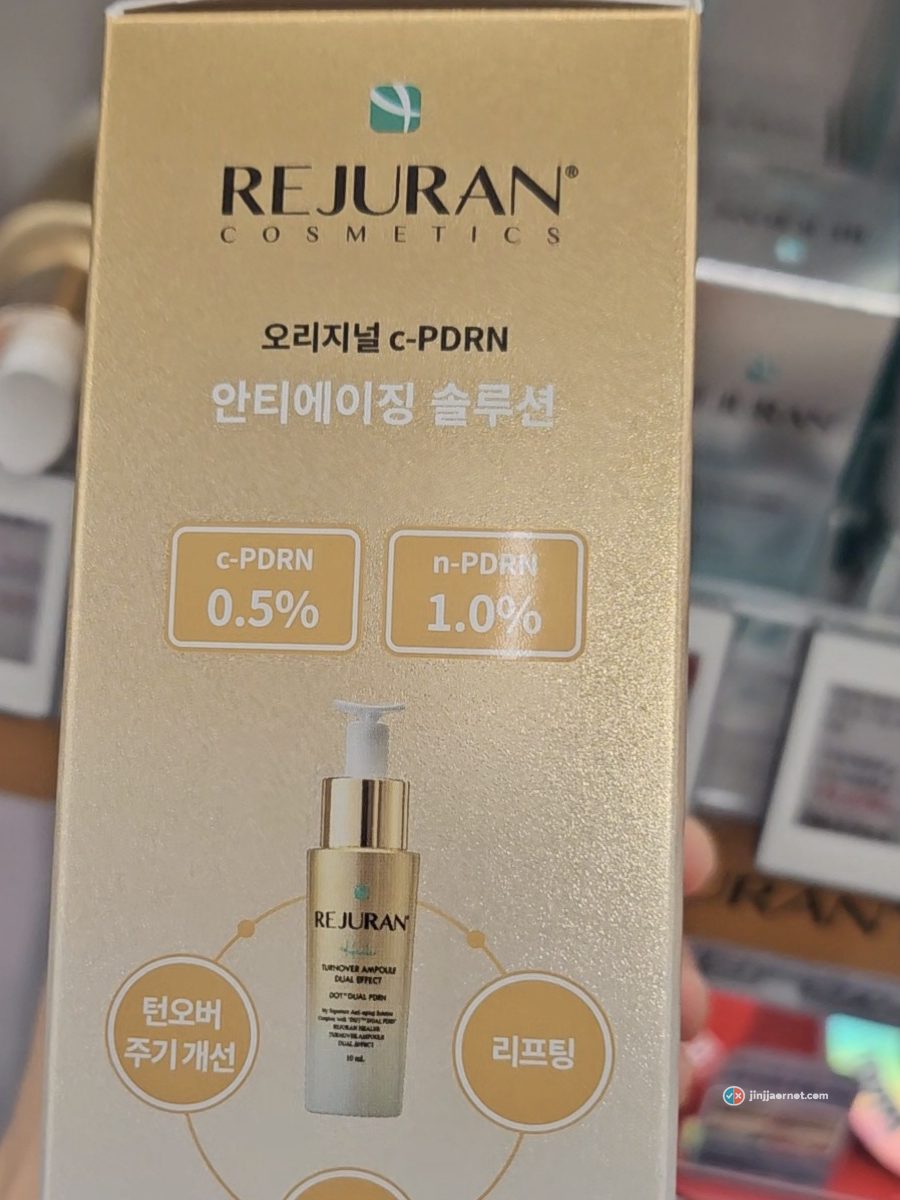
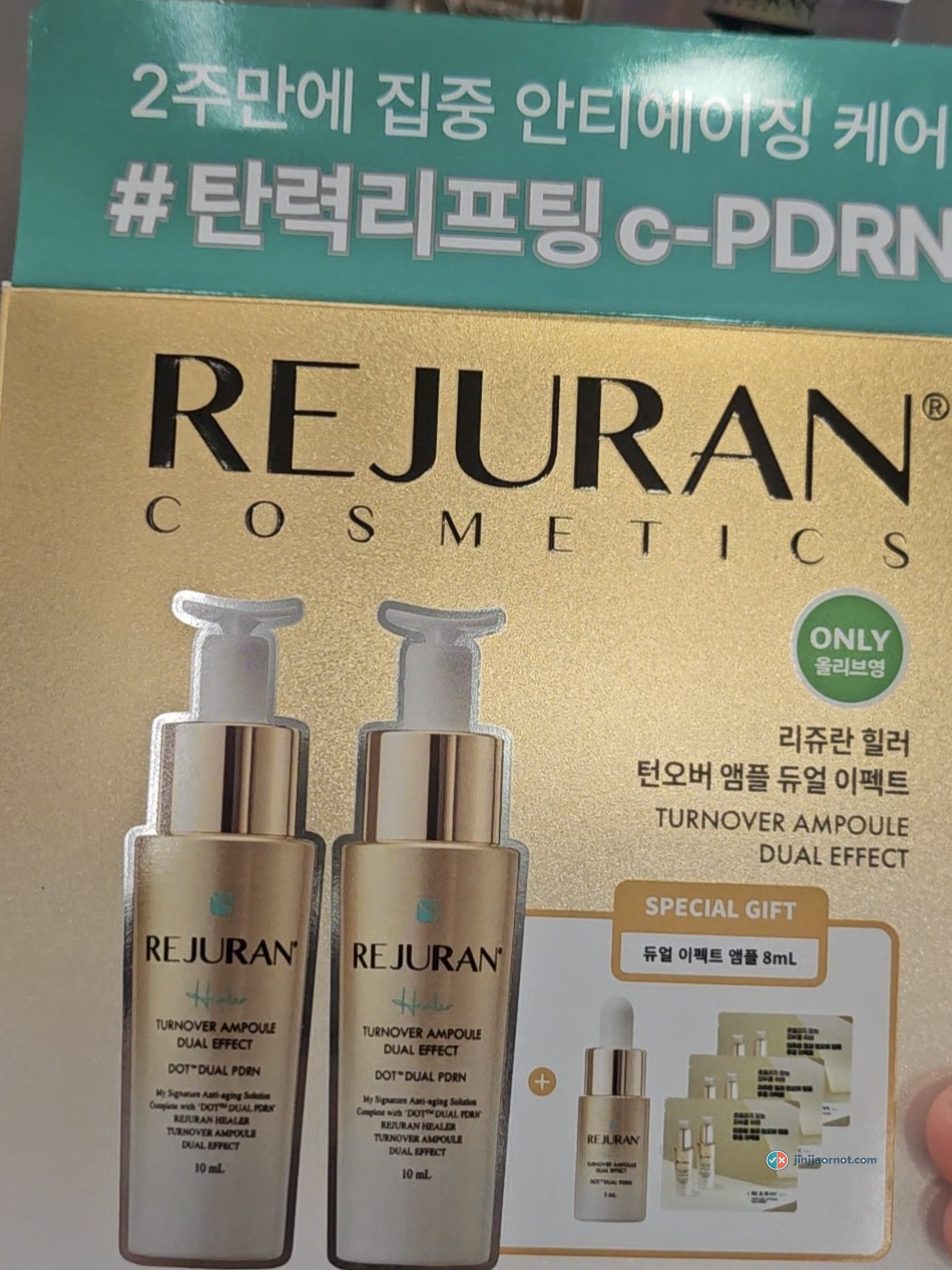
Together that is 1.5%. Most brands never publish this figure at all — you get “contains PDRN” on the front and nothing on the back.
A warning about comparing that number to anything else. On the ingredient list this appears as hydrolyzed DNA, while other PDRN products print sodium DNA, and one I saw on the same shelf is ginseng-derived. Cosmetic labelling has no ingredient called “PDRN” — the word only lives on the front of the box. So the front says PDRN on all of them and the back says three different things. Do not line the percentages up against each other and call it a ranking. I nearly did.
The two ingredients doing the legal work are not the PDRN
Here is what reading the Korean label gives you that a US listing cannot.
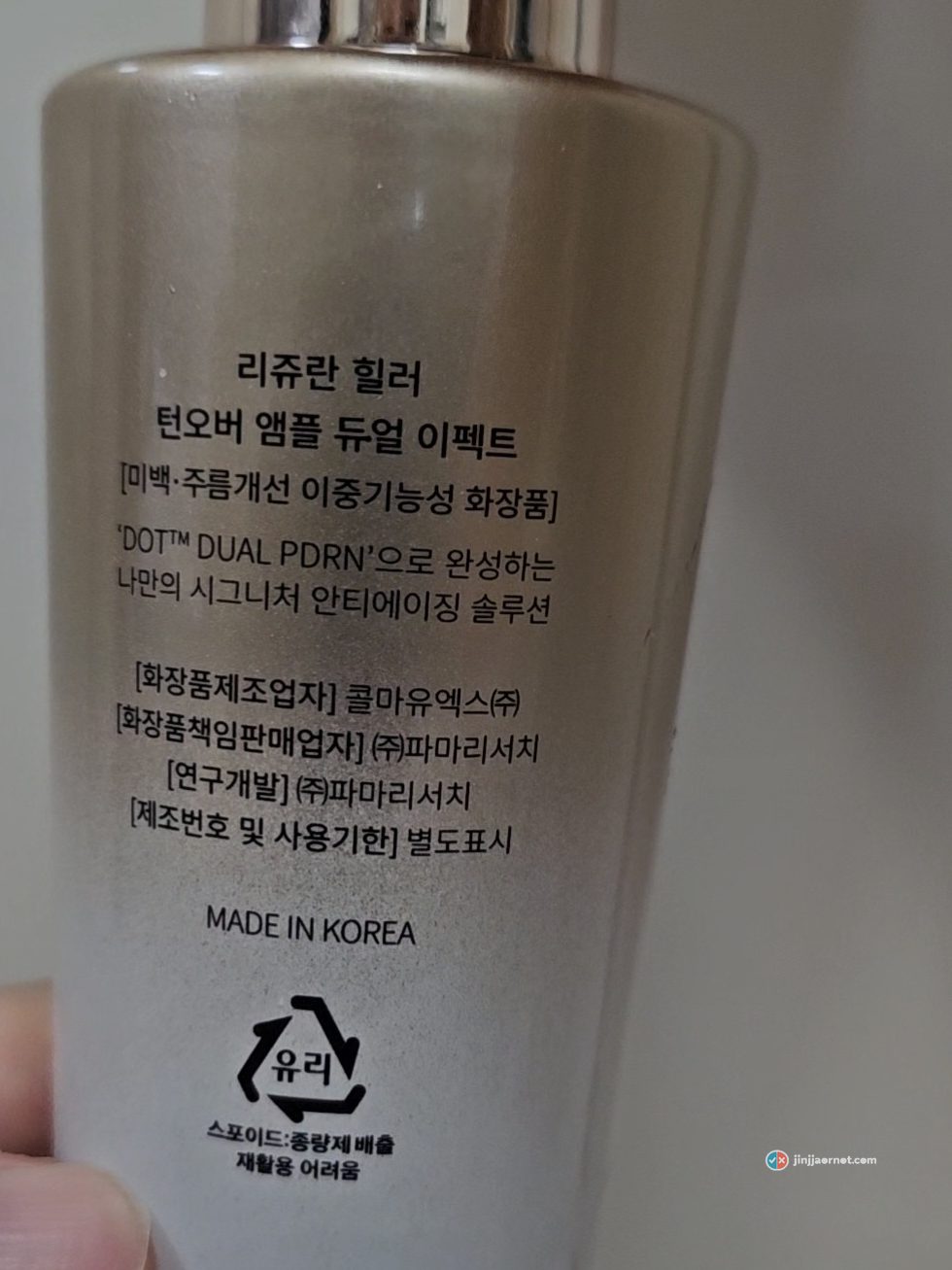
The box is marked a dual-function cosmetic, filed for brightening and for wrinkle improvement. Underneath that, in the box marked functional ingredients, it names exactly two things:
Niacinamide. Adenosine.
Those are the two ingredients Korea's regulator has approved for those two claims. PDRN is not among them. It is the brand's own ingredient and its own trademark — DOT DUAL PDRN — and the box says so directly: a proprietary complex of c-PDRN and n-PDRN.
That is not a gotcha. Niacinamide and adenosine are well-understood and the filing is honest. But it does mean the “clinically proven” line you will see attached to this bottle in English is doing something subtler than it looks. The claim that was filed is brightening and wrinkles. The ingredients carrying it are the two boring ones.
Water is the ninth ingredient
I read a lot of ingredient lists and this one stopped me.
The first eight are botanical extracts and humectants — raspberry leaf, Spanish licorice root, calendula, aloe vera leaf juice, blueberry, black mulberry fruit, PEG-6, glycerin. Purified water comes ninth. In most serums water is first by a distance.
Further down, past the niacinamide and adenosine, there is a small barrier group: ceramide NP, cholesterol, oleic acid, squalane. That combination is the standard way of not wrecking a skin barrier, and it lines up with what actually happened on my face.
There is also no fragrance in the list, and I do not smell anything when I apply it. Worth saying carefully, because in Korean skincare “no added fragrance” and “no smell” are two different things — a product can skip the fragrance and still smell strongly of its own plant oils. This one happens to be both.
How it actually behaves
It is a thin, clear gel — closer to water than to a serum. It slumps when you drop it on the back of your hand rather than holding its shape. It spreads far, sinks in fast, and leaves no slip behind. Thirty seconds later my hand does not feel like anything is on it. If you dislike the tacky film a lot of ampoules leave, this is the opposite of that.
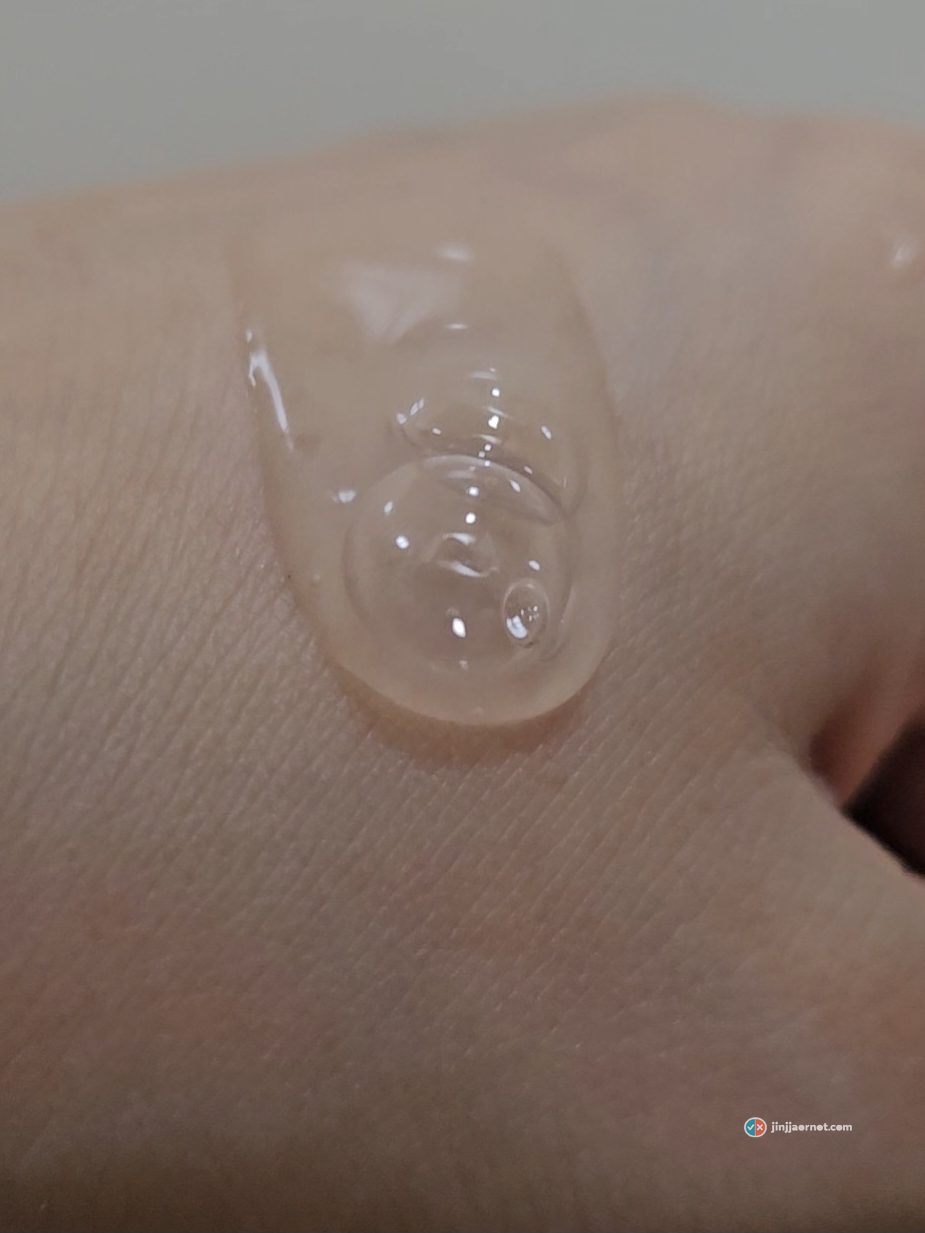
My verdict, and I want to be honest about it
Bought again. No scent. Never broke me out.
My cheeks are dry and my T-zone is oily, and I break out on my T-zone and chin when a product does not suit me. This one never has, across a long stretch of use.
Now the honest part. I do not look in the mirror and see firmer skin. What I notice is the other direction — when I stop using it, my face starts to feel like it is sitting lower. I cannot prove that is the ampoule rather than my own head, and I am not going to pretend otherwise.
That is the real shape of most anti-aging products, and anyone who tells you their ampoule rebuilt their face in four weeks is selling you something. What I can put on the record is behaviour, not belief: I keep replacing the bottle.
Who should skip it
- If you want a visible before-and-after in a month, skip. This is not that.
- If you are chasing PDRN because of the injectable, understand that the cosmetic and the procedure are different things.
- If you want something you can feel working, this is not it. It is quiet.
The bottle sold abroad is not the bottle on my shelf
I went through the export listings expecting to find my product. I did not.
| Korean box (what I use) | What ships abroad | |
|---|---|---|
| Name | Turnover Ampoule Dual Effect | Turnover Ampoule or Dual Effect Ampoule |
| Printed on the bottle | DOT DUAL PDRN | DOT DUAL c-PDRN |
| Concentrations shown | c-PDRN 0.5% + n-PDRN 1.0% | c-PDRN 0.5% |
Both export listings I found — the official Amazon store and the Korean-beauty retailers — print c-PDRN 0.5% on the bottle and describe c-PDRN only. n-PDRN does not appear anywhere in their copy. The word “dual” is still in the name, but abroad it is attached to the delivery technology rather than to two different PDRNs.
I am not going to tell you the export version is worse, because I have not used it and its label does not tell me enough to say that. What I can tell you is the thing the listings do not: if you are buying it because you read about c-PDRN and n-PDRN, check the bottle in the listing photo. The number is printed right there under the product name.
One more thing worth noticing, since it sits next to my verdict. The export pages say the ampoule is clinically proven to lift and firm the cheeks, 14.10% in two weeks, with a before-and-after pair to match. My own experience after far longer than two weeks is the quiet version I described above. Both can be true — a measured instrument and a face in a bathroom mirror are not the same test — but you should know which one you are reading.
What it costs, and what to do with that number
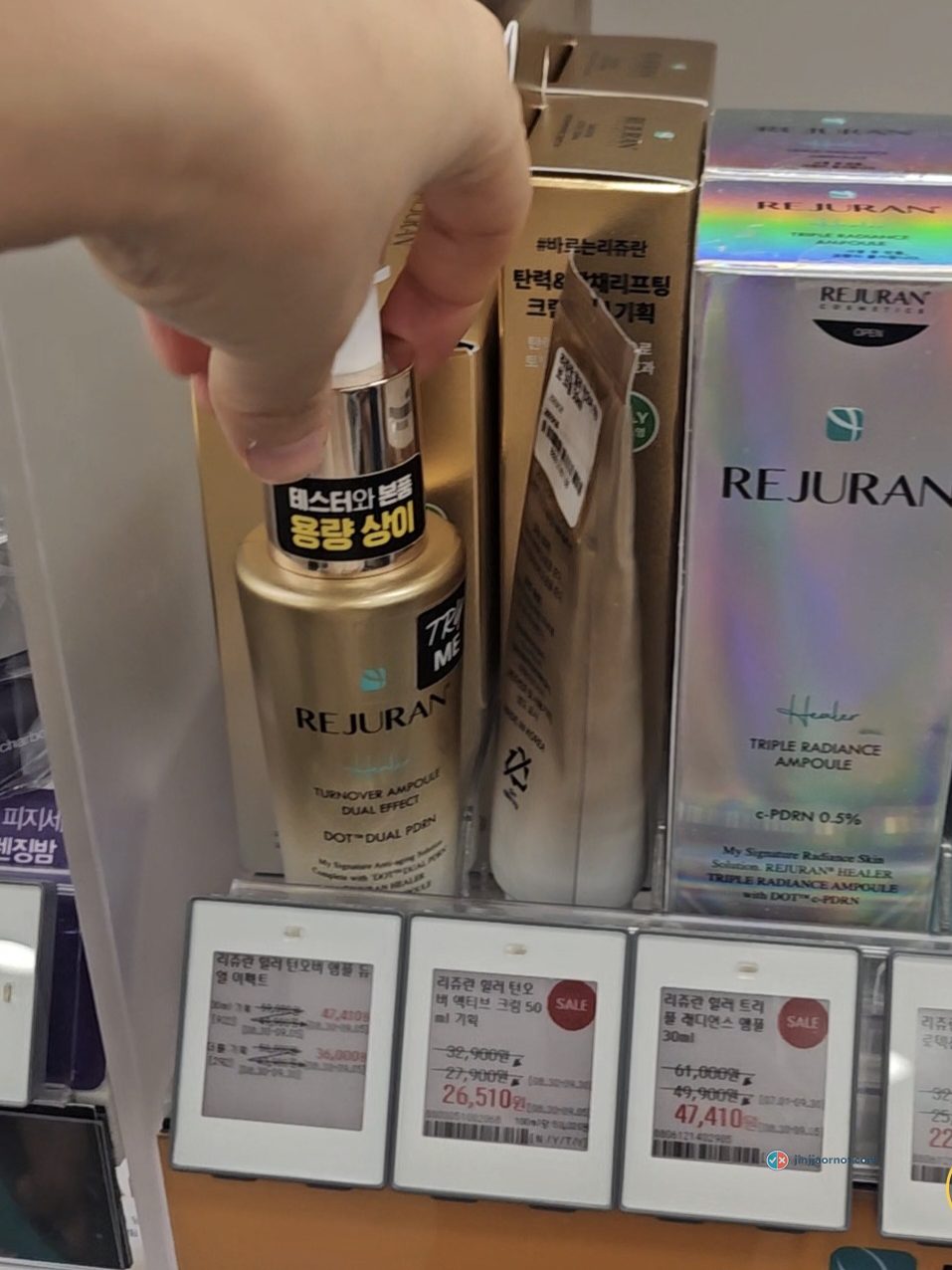
On a Korean shelf the 30ml set sits under 50,000 won in the sale cycles I have seen. The same 30ml runs around $55 on export sites, and I found listings across a range of roughly $33 to $78 for the same thing.
In the UK store the two versions sit at £39 for the Turnover Ampoule and £41 for the Dual Effect Ampoule, both 30ml. I checked those myself the same day I wrote this. I do not have an affiliate link for the UK store, so that is a number rather than a button.
You cannot shop at my Olive Young, so the useful part is not “it is cheaper here.” The useful part is that now you know the floor. If a listing is well past $60 for 30ml, that is not the market rate, that is the seller. And if a listing quotes you a PDRN figure that does not match the box — I saw one advertising 5,000ppm — the box is right and the listing is not.
Also on Stylevana
Rejuran Dual Effect Ampoule — the c-PDRN 0.5% version, which is what actually ships outside KoreaUS →These are affiliate links, tracked through Awin — if you buy through one I may earn a small commission, at no extra cost to you. It opens a search rather than a fixed product page, because Stylevana re-issues its product addresses. Search checked 5 Sep 2026.
Rejuran Turnover Ampoule FAQ
Is the Rejuran ampoule the same as Rejuran Healer injections?
No. Same company and the same ingredient family, but they are different products. The ampoule is a cosmetic you apply at home; the injection is a clinical procedure.
Is the version sold outside Korea the same product?
No, not exactly. My Korean box prints c-PDRN 0.5% and n-PDRN 1.0%. The bottles sold abroad print c-PDRN 0.5% and their copy does not mention n-PDRN at all. Check the bottle in the listing photo before you buy.
What is the difference between c-PDRN and n-PDRN?
They are PharmaResearch's own two forms, combined into what the brand trademarks as DOT DUAL PDRN. The Korean box prints them separately: c-PDRN 0.5% and n-PDRN 1.0%.
Does it have fragrance?
There is no fragrance in the ingredient list on my box, and I cannot smell anything when I apply it. Formulas get revised, so check the box you receive.
Why is PDRN not listed in the ingredients?
Cosmetic ingredient lists have no ingredient called PDRN. It appears under names like hydrolyzed DNA or sodium DNA. That is why the front of the box and the back of the box can look like they are describing different things.
Is it good for oily skin?
It left no film on me and my T-zone is the oily part of my face.
What does it cost in Korea?
The 30ml set sits under 50,000 won on the shelf in the sale cycles I have seen, against around $55 for the same size on export sites.