☀️ K-Beauty · Swatch Test
Korean Tone-Up Sunscreen: Does the Shade Actually Matter?
Heads up: some links below are affiliate links, which means I may earn a small commission if you buy through them — at no extra cost to you. These two came free as samples with an Olive Young order. Nobody paid me and nobody saw this before you did.
The short answer
The glow is real. Both make p:rem shades (often spelled makeprem) are SPF 50+ PA++++ and look nearly identical once absorbed — so choose by undertone, not shade name: pink for pink undertones, beige for yellow. It wears best in cool, mild weather. Worth it — in the right conditions
If you've only ever used Western sunscreen, the whole category needs explaining first. So let's do that, then I'll show you the hand.
A quick note on wording: I say sunscreen here, but if you're in the UK, Ireland, Australia or New Zealand you probably call it sun cream or suncream — and what you'd call factor 50 is what Korean bottles print as SPF 50+. Same thing. Korean labels just add the PA rating on top, which most Western bottles don't show at all.
What "tone-up" sunscreen actually is
In the US and Europe, the highest praise a sunscreen can get is that it disappears. No white cast, no tint, invisible. Whole product lines are built on that promise.
Korean tone-up sunscreen does the opposite on purpose. It's tinted, and it's meant to leave a soft brightening veil on your face. The idea is that one product does two jobs: SPF, plus the "my skin but better" look you'd otherwise reach for a base product to get.
So when a Korean reviewer says a tone-up sunscreen "casts," that isn't a complaint. That's the feature. Whether you'll like it is a completely different question, and it depends a lot on your skin tone — more on that below.
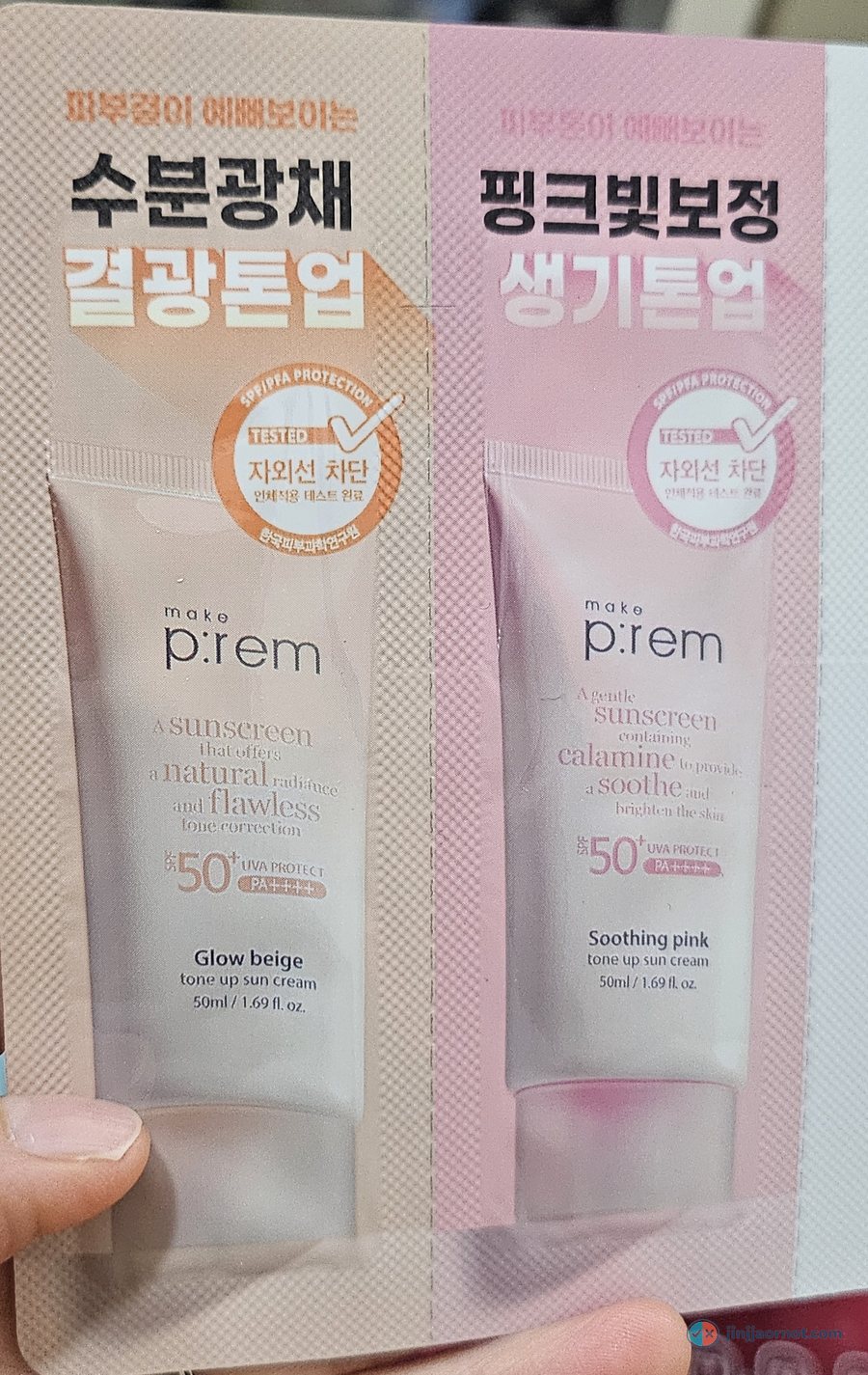
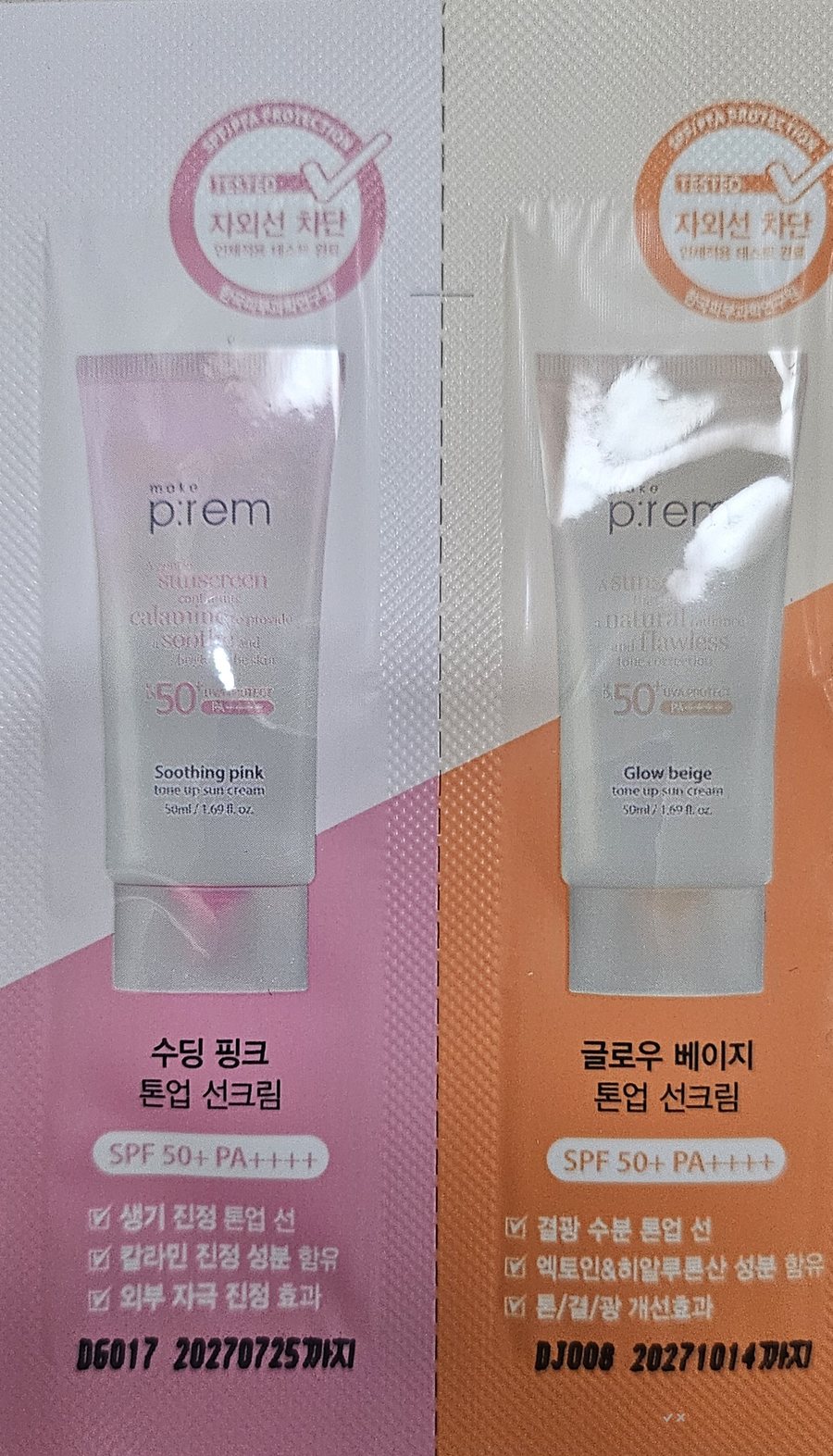
The two shades, on paper
| Glow Beige | Soothing Pink | |
|---|---|---|
| SPF | SPF 50+ PA++++ | SPF 50+ PA++++ |
| Tint | Beige | Pink |
| Headline ingredients | Ectoin, hyaluronic acid | Calamine |
| Brand's angle | Tone, texture and glow care — a hydrated, radiant finish | Calming skin stressed by external irritation, evening out tone |
| Size | 50ml / 1.69 fl oz | 50ml / 1.69 fl oz |
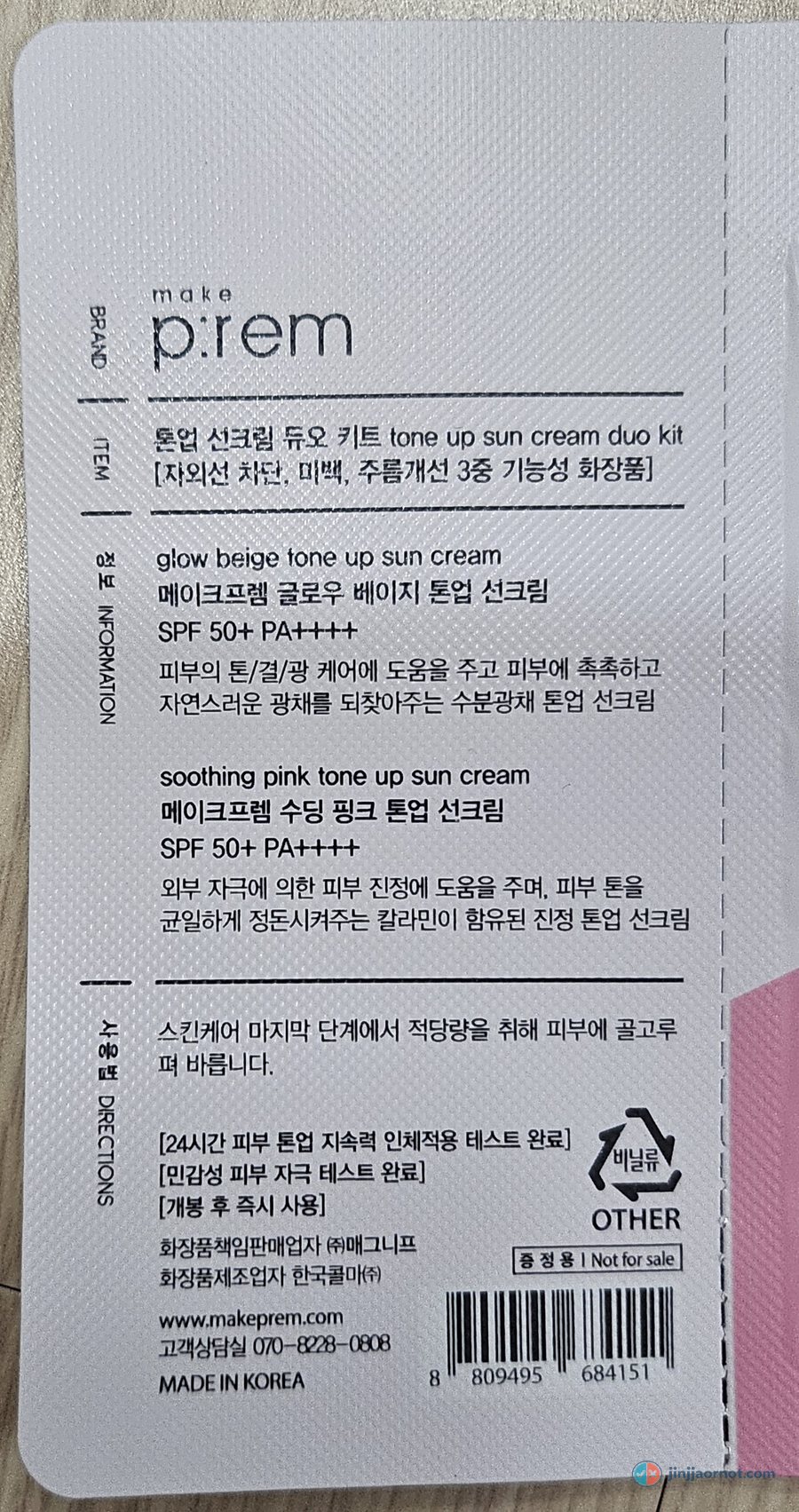
One thing worth explaining for non-Korean readers: the box calls this a triple-functional cosmetic — UV protection, brightening and wrinkle improvement. That's a Korean regulatory labelling category, not a promise that it'll transform your face. Korean cosmetics can register in specific functional categories, and brands print it because it's a real classification here. Treat it as a label, not a result.
Going on: they really are different
Squeezed out, the two textures are very similar — smooth, lotion-like, not thick.
The difference shows up the moment you spread them.
- Soothing Pink looks like it's sitting on top of the skin. There's a moment where it reads as a layer rather than as your skin — a slight floating, pinkish film.
- Glow Beige matches my skin tone much more closely from the start. It looks natural almost immediately.
If you only ever looked at the first thirty seconds, you'd conclude these are two genuinely different products and that the beige is the safer buy.
After it absorbs: this is the part nobody tells you
Here's the same hand once both had settled. Left is Glow Beige. Right is Soothing Pink.
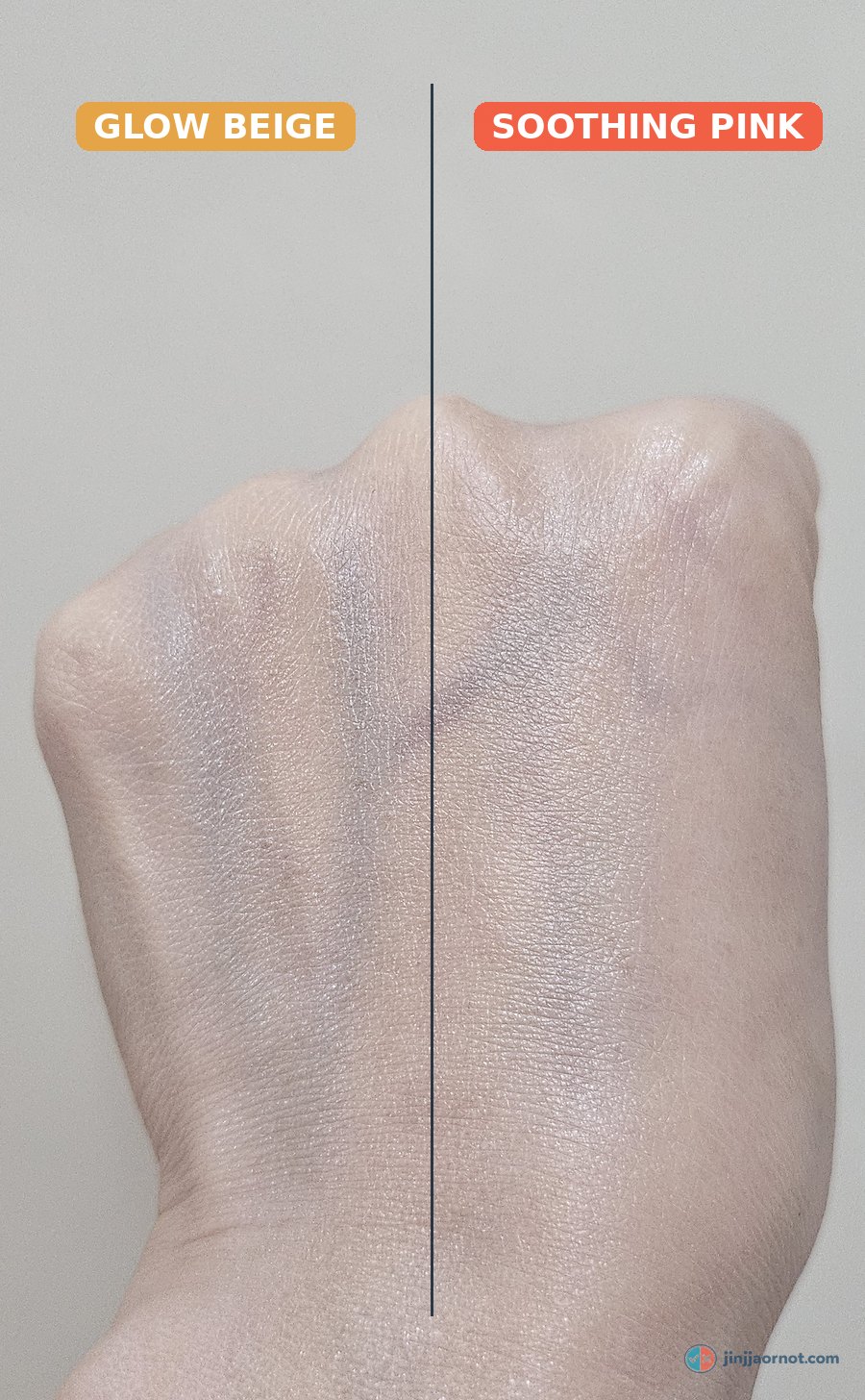
Cover the labels and try to call it. I couldn't, and I'm the one who applied them — on the back of a hand, in one light, side by side. That's the toughest place to spot a gap.
Once absorbed, the difference is very small — hard to separate by eye. I'm not going to tell you the two are identical, because they're not: someone who is genuinely sensitive to colour, or who wears these on the face daily in different light, may well pick up a difference I can't. But at normal viewing distance, on my skin, I couldn't reliably tell which side was which.
I even went further and measured the photo — sampling warm-versus-cool colour values straight across the back of the hand, left edge to right edge. The numbers wander up and down, but there's no clean boundary where beige stops and pink starts. The measurement agrees with my eyes.
Good news: you can stop agonising over the shade
Both land in a very similar place once they settle, so there's no wrong answer here. Choose on undertone and on the active you want — and buy with confidence either way.
So how do you pick?
Before the swatch talks you out of caring: a small difference on the back of a hand is not a small difference across a whole face. Two patches side by side is the hardest possible test to see a gap in — and even then the direction is there. Spread that same tint over your entire complexion and a subtle undertone shift becomes something you'd actually notice.
So the shade choice isn't meaningless. It's just that two things decide it, and neither is the name on the box.
- Your undertone. Even though the finishes land close, Soothing Pink still leans cool and Glow Beige still leans warm. If you know you're a cool tone, pink is the more natural match; if you're a warm tone, beige is. That's the real difference between them.
- The active you want. Calamine (pink) if your skin flushes and gets irritated easily. Ectoin and hyaluronic acid (beige) if you're after hydration and glow.
What it's genuinely good at
The glow lives up to the name
I applied this to bare skin with nothing underneath — no toner, no moisturiser — and it still gave a soft, lit-from-within finish. Not glittery, not greasy-looking. Just skin that reads healthier. If "glow" is what you came for, this delivers on it, and that's the whole reason to buy a product like this.
It doesn't feel suffocating
A lot of tone-up products feel heavy and occlusive — that slightly stifling layer sitting on your face. This one doesn't. It spreads smoothly, moves with the skin, and never feels like a mask. That's genuinely hard to get right in a tinted mineral formula.
Two jobs, one step
SPF 50+ PA++++ plus a light evening-out of tone. On days when you'd otherwise reach for sunscreen and a base product, this collapses it into one.
When to wear it — this is the important part
Here's the thing I most want you to take away, because product pages never tell you this.
The formula has a rich, emollient feel to it. That's exactly why the glow looks the way it does — but it also means the finish behaves very differently depending on the weather you're wearing it in.
| Conditions | How it performs |
|---|---|
| Cool, mild, dry weather | 🟢 This is its element. The richness reads as glow, the finish stays put, and skin looks great for hours. |
| Hot, humid weather | 🟡 The same richness works against it. Combined with your own oil, the finish breaks down faster and doesn't hold as well. |
So if you live somewhere with real seasons, think of this as your cool-weather sunscreen — the one you reach for when the air turns crisp. And if you're somewhere warm year-round, it's still a great option for air-conditioned days, evenings and indoor-heavy days rather than a beach afternoon.
Want it to last in the heat? There's an easy fix
Set it. A light oil-controlling powder, a mattifying base, or a makeup fixer over the top holds the finish together in humidity. That one extra step turns this from a cool-weather product into a year-round one.
A note on skin type
Dry or normal skin will love this — the emollient feel is a feature, not a flaw, and that's where the glow really pays off. If your skin runs oily, it's not a no, but I'd swatch first and plan on setting it. Korean brands hand these out as sample sachets constantly, and plenty of US retailers do deluxe samples too — worth using one before you commit to a full tube.
And a note on skin tone
I'm testing on fair-to-medium Korean skin, which is squarely the tone these are formulated around. A pink-tinted tone-up sunscreen behaves very differently on deeper skin, where it's far more likely to read as visible or ashy. I can't test that and won't pretend otherwise — if your skin is deeper than mine, treat every tone-up swatch photo online, including this one, as information about someone else's face.
New to Korean skincare?
I'm building an honest, from-a-Korean guide to the K-beauty actually worth your money — no hype, no 10-step pressure.
See what's actually worth it →So which one should you get?
- Glow Beige — if you're a warm tone, or you want the most natural-looking match with a hydrated glow. This is the easy default and the one I'd hand to someone who just wants it to work.
- Soothing Pink — if you're a cool tone, or your skin flushes and gets irritated easily and the calamine appeals.
- Either way you're fine. They land close enough that you won't regret the call. Buy the one whose ingredient list matches your skin and stop there.
Where to buy in the US
Both shades are sold in the full 50ml size on Amazon US, and on YesStyle, which is an authorized retailer of make p:rem and ships worldwide.
Check the number on the listing photo. The tubes I tested are the Korean-market ones, both printed SPF 50+ PA++++. If a listing shows a different number, that is the version filed for your market — sunscreen is tested and labelled to national rules, and the US does not print the PA rating at all. It would still be a real make p:rem tube, just not the one I wore.
Also on Stylevana
make p:rem Soothing Pink Tone UpUS →These are affiliate links, tracked through Awin — if you buy through one I may earn a small commission, at no extra cost to you. I only link the regional stores I am approved for and have checked myself. They open a search rather than a fixed product page, because Stylevana re-issues its product addresses and I would rather send you to a live shelf than a dead link. Checked 31 Aug 2026.
One thing to check before you order: what I tested was the Korean sample duo kit, marked "not for sale" — the free sachets brands hand out with orders here. It's the same product, just a single-use portion. The retail version is the 50ml tube.
My honest take
This is a good sunscreen, and I'd point people to it. The glow is real, it doesn't feel heavy, and it does two jobs in one step. Applied to bare skin with nothing else underneath, it still made my hands look better — that's a fair test and it passed.
What I'd tell a friend: buy it for cool, mild weather and treat it as a glow product rather than a sweatproof one. In heat, set it with powder or a fixer and it'll behave. Pick beige if you're warm-toned, pink if you're cool-toned, and don't lose a single minute agonising over which shade looks better — I swatched them side by side so you don't have to.
Tone-up sunscreen FAQ
What is tone-up sunscreen?
It's a tinted sunscreen that deliberately brightens the look of your skin as well as protecting it. Western sunscreens usually try to vanish; Korean tone-up sunscreens leave a soft brightening veil on purpose, so the product doubles as a light base. They still carry full SPF ratings — these two are SPF 50+ PA++++.
What does PA++++ mean on Korean sunscreen?
SPF measures protection against UVB — the rays that burn you. PA measures protection against UVA — the rays that age skin and pass through window glass. The plus signs are the strength: PA+ is some protection, and PA++++ is the highest grade on the scale. You'll see it on almost every Korean sunscreen, including both of these. US labels use "broad spectrum" for roughly the same idea, but without the four-step rating, which is why Korean bottles look more specific.
Can you buy Korean sun cream at Boots or Superdrug?
Korean skincare has properly landed on the UK high street — Superdrug now runs a large Korean Beauty range in-store and online through a partnership with the K-beauty retailer PURESEOUL, and Boots has its own Korean skincare section. But both carry a curated shortlist of brands rather than everything, and make p:rem generally isn't one of them. So for these specific tone-up creams, ordering from a K-beauty site that ships to the UK is still the realistic route. Stock changes constantly, so it's worth a quick search on either site before you order from abroad.
Is Korean factor 50 the same as SPF 50?
Yes. Factor 50 is just the British way of saying SPF 50 — same measurement, same scale, different habit of speech. The difference on a Korean bottle is the extra PA++++ rating next to it, which grades UVA protection separately. So a Korean SPF 50+ PA++++ sun cream tells you more about what it blocks than a UK factor 50 bottle usually does, not less.
Is makeprem the same as make p:rem?
Yes — one brand, several spellings. It's officially styled make p:rem with a colon, but retailers list it as MAKEPREM and shoppers usually type make prem. If you're searching and getting nothing, drop the colon. The sun range is called UV Defense Me, which is why "defense me sunscreen" turns up in searches too.
How is the tone-up sunscreen different from the Sun Fluid, Sun Essence or Sun Stick?
They're separate products in the same UV Defense Me range. The tone-up creams I tested here are the tinted ones — they brighten as well as protect. The Sun Fluid, Sun Essence and Sun Stick are untinted, so they're what you want if you'd rather your sunscreen disappear than glow. I haven't tested those three, so I'm not giving you a verdict on them — when I do, it'll be its own article.
What's the difference between Glow Beige and Soothing Pink?
Same brand, same SPF 50+ PA++++. Glow Beige is built on ectoin and hyaluronic acid for a hydrated, glowing finish. Soothing Pink contains calamine and targets skin irritated by external stress. Going on, the pink reads more as a layer and the beige blends closer to skin tone — but once absorbed they're hard to tell apart by eye.
Does tone-up sunscreen leave a white cast?
A subtle cast is the point of a tone-up sunscreen, not a defect. On my fair-to-medium Korean skin, the pink looked like it was sitting on top at first and the beige matched more naturally. On deeper skin tones, a pink tone-up sunscreen is much more likely to read as visible or ashy — swatch before you commit.
Is tone-up sunscreen good for oily skin?
Dry and normal skin will get on best with this one — the emollient feel is what creates the glow. If your skin runs oily it isn't a no, but set it with a light oil-controlling powder or a makeup fixer, and swatch a sample before committing to a full size.
Does make p:rem tone-up sun cream last all day?
It depends far more on weather than on hours. In cool, mild, dry conditions the finish holds well and looks great. In heat and humidity, the rich texture combined with your own oil means it breaks down faster. The fix is simple: set it with a mattifying powder, an oil-controlling base or a makeup fixer and it holds up.
Which shade suits cool tones and which suits warm tones?
Soothing Pink leans cool and Glow Beige leans warm. The two finishes land close together in a hand swatch — but a hand swatch is the hardest place to see a gap. Spread across a whole face, a subtle undertone shift is something you'd notice, so it's still the thing I'd choose on, rather than the shade name or the marketing copy.
What does "triple-functional" mean on Korean sunscreen?
Korean cosmetics can be officially registered in specific functional categories. This kit is labelled triple-functional for UV protection, brightening and wrinkle improvement. It's a Korean regulatory labelling category — useful context, not a promise of results.
Where can I buy make p:rem tone-up sun cream in the US?
Both shades are on Amazon US in the 50ml size, and on YesStyle, an authorized make p:rem retailer that ships worldwide.